


Since Narendra Modi’s right-wing Hindu nationalist party swept to power in 2014, India has gradually become a minimum democracy. There are regular elections, but democracy seems to have stopped there.
India just witnessed an unprecedented youth-led movement demanding the resignation of a minister in Modi’s cabinet. It began as an online satire, an Instagram account named “Cockroach Janata Party” (CJP) subtly reclaiming the mockery by the Chief Justice of India, who called the country’s unemployed youth “cockroaches” and “parasites”.
What was an insult turned into an overnight sensation, with the Instagram account and its founder, Abhijeet Dipke, amassing more than 22 million followers in just two weeks.
Indian youth have long been dismayed by the employment situation and resentful of corruption and institutional failure. Youth resentment became clearer when the government failed to acknowledge the question paper leaks in India’s largest medical entrance exam, known as NEET. When the exam was cancelled after leaked papers surfaced on Telegram, more than 2 million candidates were affected, and at least twenty of them had died by suicide. The government refused to take proper action, and the minister refused to resign.
The CJP-led student movement began with the demand for the resignation of India’s education minister, Dharmendra Pradhan.
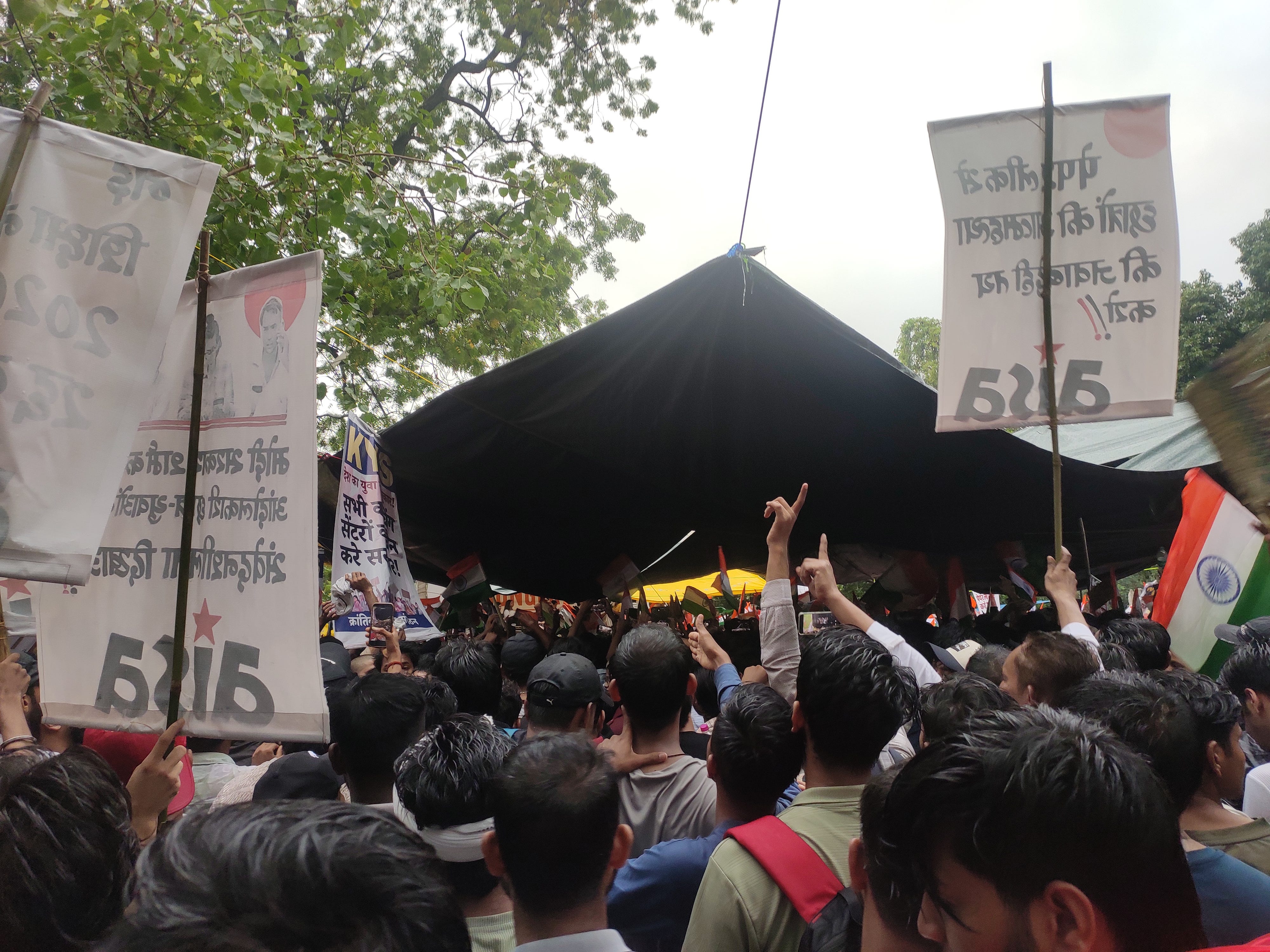
After a prolonged hunger protest by several students, along with Sonam Wangchuk, a prominent educationist and social activist from the Indian state of Ladakh, and the government’s eventual failure to address their concerns, on July 20, 2026, students and parents from all over India gathered at Jantar Mantar to march towards the Indian parliament.
Families who had lost their sons and daughters marched holding their photos, demanding justice. Students chanted slogans of “Inquilab Zindabad” (Long Live the Revolution) and “Modi Teri Tanashahi—Nahi Chalegi, Nahi Chalegi” (Modi, Your Dictatorship, Will Not Be Tolerated). And the police—nametags removed, so that no one holds them accountable—charged the protesters, beating them with batons, firing tear gas and using pellet guns.
Days after relentless mobilisation across India and the increased youth resentment towards the Modi government, Pradhan, who had dismissed the student movement as “B-team of terrorists”, has since resigned, and within hours, a new minister was appointed in his place.
But the protest mobilisation calling for the resignation of a minister following an institutional failure is a new low for Indian democracy. Not so long ago, during the coalition era of Indian politics, whenever a scandal broke out, independent agencies plunged into action, reports were published, and eventually, the ministers and top-tier bureaucrats resigned. Whenever there was a railway accident, a large-scale policy failure, or a corruption scandal, the ministers would resign on moral grounds.