


Ethnic conflict between the Sinhalese and the LTTE in Sri Lanka crippled the nation for over five decades. It had resulted from long-drawn appeasement policies and manipulations by the political parties, all through Sri Lankan political history. Sri Lanka, an island nation in the Indian sub-continent, constitutes 74 per cent of Sinhalese Buddhists, Tamil (Hindus) comprised 18 per cent, and Tamil (Muslims) constitute 7 per cent of the population.[1]
Soon after Sri Lanka's independence, Sinhalese leaders began to appease the Sinhala Buddhist majority. Over the years, the Tamil population resented the majority domination, ultimately culminating in the Liberation Tigers of Tamil Eelam (LTTE) in 1976.
The LTTE had waged a violent campaign against the Sinhala majority. In the process, the LTTE suppressed its population by virtually establishing itself as a Tamil state. It was the “longest active secessionist movement” until its defeat in 2009.[2]
In this article, I aim to examine the political nature of the Sri Lankan state that facilitated the crisis's unfolding and to highlight the structural and temporal factors at play. I will further discuss the political transformation of the conflict over a specific period, culminating in its controversial conclusion in May 2009.
Colonialism and Ethnic Conflict in Sri Lanka
The conflict began to take its violent shape after the 1983 pogrom. However, the structural roots of the conflict could be seen in the communal policies of British rule in Sri Lanka. The British Colonial policy of “Divide and Rule”, devised to govern the ethnic groups in Sri Lanka, provides us with evidence for the genesis of the ethnic conflict.
The systematic “Us v/s Them”, as documented in the Donoughmore and Soulbury Commissions in the form of “communal representation”, enabled the ethnic groups to seek and dominate national politics. As Shafi and Rashid note,
The British Governor had nominated members to the legislature based on ethnicity (Sinhala, Tamil, Muslim and Burgher).[3]
With Sri Lanka's independence in 1948, a clear sign of disarray emerged within both the Tamil and Sinhala leadership. Colonialization and British policies remain important factors in the ethnic conflict of Sri Lanka.[4]
Identity Creation of Sinhala
The assertion of Sinhala identity remained an important political goal for the Sri Lankan state. As a result, the creation of Sinhala identity began with palingenesis, the process of recreating the past, using elements of the “origin” mythology.
Shafi and Rashid write: “Sinhala, it was claimed, were decanted from Aryan migrants from Bengal in the fifth century BC; the arrival of their leader, Prince Vijaya, in Sri Lanka coincided with the death of the Buddha.”[5] As an ideological response, Tamils began asserting their pure Dravidian heritage, claiming that their ancestors were part of the Harappan civilisations of India and that they were the original inhabitants of Sri Lanka.
Sinhalese Only Bill of 1956
In the 1950s, Sinhalese politicians began to attract the masses by promoting the establishment of a Buddhist-Sinhalese state in Sri Lanka. The increased electoral politics based on ethnicity and language took its final form in the “Sinhalese Only Bill” (Official Language Act, No. 33 of 1956).
S.W.R.D. Bandaranaike, leader of SLFP, used “indigenous nationalism” to win the 1956 general elections, with the promise of making “Sinhalese language the official language of Sri Lanka” and “assertion of Buddhism in the region.”[6]
This act is an important structural factor in shaping the political character of the Sri Lankan state. It also gave rise to ethnic clashes between the Sinhalese and Tamils in 1958, 1977, and 1981.[7]
Some of the temporal factors that could be enlisted in the assertion of the state's political character include the creation of the Tamil Tigers, the Pogrom of 1983, and State-sponsored settlements in Tamil areas.
Birth and the Rise of the LTTE
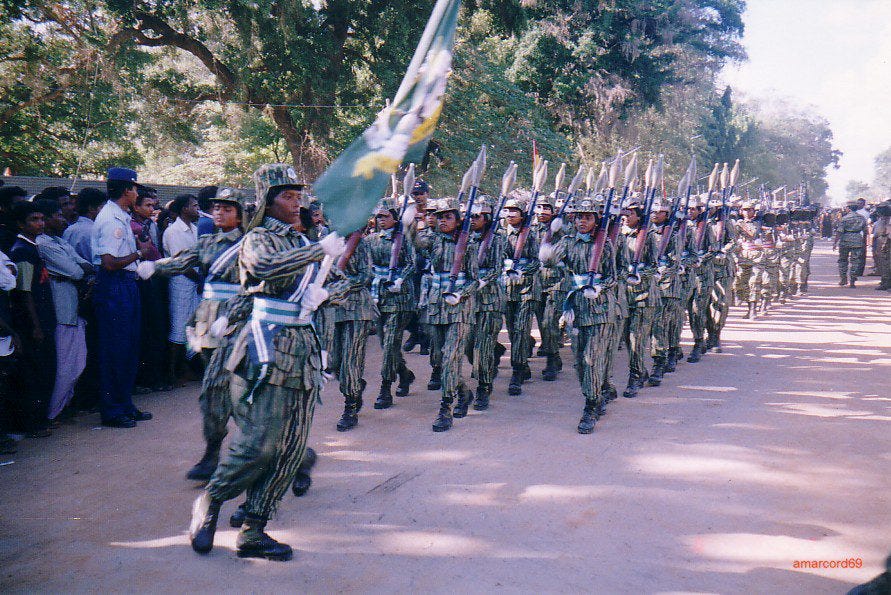
The Tamil minority feared the loss of access to education and employment as a consequence of communal policies in admissions in favour of Sinhalese students—the resentment among the Tamil youth accumulated in the Liberation Tigers of Tamil Elam (LTTE). In the early 1980s, the LTTE carried out a series of bank robberies, assassinated several police officers, and carried out bomb attacks in the Sinhalese-dominated south.[8]
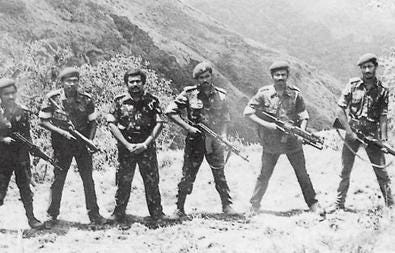
The “1983 Pogrom against the Tamil civilians” in Colombo could be another temporal factor for the ethnic conflict in Sri Lanka. In July 1983, the LTTE attacked and killed 13 Sinhalese soldiers in Jaffna, leading to a severe counterattack by the armed forces on Tamil civilians. [9] Many scholars have noted the “1983 riots” as the turning point in Sri Lankan ethnic violence.[10] Four days after the violence broke out, President Jayewardene said:
I believe there was a significant anti-Tamil sentiment among the forces. They also felt that shooting the Sinhalese, who were rioting, would have been anti-Sinhalese, and, in some places, we saw them encouraging [rioters].[11] Since the beginning of the civil war in 1983, the LTTE has been at the forefront of the theatre of guerrilla warfare and the struggle for territorial control.
Ethnic Conflict in Sri Lanka and the LTTE
Another pertinent temporal factor was, as Thangarajah has labelled, “frontiersmen”: politically motivated Sinhalese farmers settled in the Tamil region under new irrigation schemes and received weapons to fight Tamil militancy.[12] The state-sponsored settlement schemes allowed for large-scale irrigation for Sinhalese farmers in the Tamil-inhabited areas of the East.
At this juncture, I will address how the conflict unfolded until its end in May 2009. As early as 1983, India had made serious efforts at containing the crisis and negotiating with both the Tamil Tigers and the Sri Lankan Government. The outcome was the India-Sri Lanka Accord signed by Prime Minister Rajiv Gandhi and President Jayewardene in July 1987.
Conclusion: LTTE and Sri Lanka
Accordingly, Tamil guerrilla would lay down their arms, and Indian Peace-Keeping forces were to moderate in Tamil regions. In return, Tamils would be given a degree of autonomy.[13] However, the Tamil Tigers did not accept it, and there was increased violence between the two parties.
In 2002, the Norwegian-led peace process was an unsuccessful ceasefire, as the LTTE did not accept the terms of the agreement. The final collapse of the LTTE, which kept the war going for over 25 years, came in 2009. The Sri Lankan forces launched an offensive in East Sri Lanka, often massacring civilians, raping and violently killing thousands, and ending the civil war in May 2009.
Post Script: This article was written as a part of my coursework for the Master's in Political Science at the University of Delhi.
Photo Credit: Sri Lanka Ethnic Divisions Illustration by Greg Groesch/ The Washington Times
References:
[1] “Population Pyramids of the World from 1950 to 2100,” PopulationPyramid.net, accessed March 16, 2020, https://www.populationpyramid.net/sri-lanka/1980/)
[2] “THE ETHNIC CONFLICT IN SRI LANKA: A HISTORICAL AND ...,” accessed March 15, 2020, http://documents.worldbank.org/curated/en/727811468302711738/pdf/677060WP00PUBL0io0political0Outline.pdf
[3] Shafi, A.T.M. Abdullahel and Harun-Or-Rashid, “Ethnic Conflict in Sri Lanka: A Critical Analysis”, International Journal of Research in Humanities, Arts, and Literature 1, no. 3 (2013): 17-34
[4] “The Evolution of Ethnic Conflict in Sri Lanka,” accessed March 16, 2020, https://refuge.journals.yorku.ca/index.php/refuge/article/download/21726/20396/0)
[5] Shafi and Rashid, “Ethnic Conflict”, 22
[6] Perera, Jayantha, “Political Development and Ethnic Conflict in Sri Lanka,” OUP Academic (Oxford University Press, January 1, 1992), https://academic.oup.com/jrs/article/5/2/136/1543751)
[7] Shafi and Rashid, “Ethnic Conflict”, 28
[8] Perera, “Political Development”, 138
[9] Benedikt Korf, “Functions of Violence Revisited: Greed, Pride and Grievance in Sri Lanka's Civil War - Benedikt Korf, 2006,” SAGE Journals, accessed March 16, 2020, https://journals.sagepub.com/doi/abs/10.1191/1464993406ps131oa)
[10] PERUMAL, C. A., and R. THANDAVAN. "ETHNIC VIOLENCE IN SRILANKA: CAUSES AND CONSEQUENCES." The Indian Journal of Political Science 50, no. 1 (1989): 1-17. Accessed March 16, 2020. www.jstor.org/stable/41855403.
[11] Perera, “Political Development”, 142
[12] Thangarajah, Y. “Ethnicisation of the devolution debate and the militarization of civil society in northeastern Sri Lanka,” in Mayer, M., Rajasingam Senanayake, D. and Thangarajah, Y. ed. (2003), Building local capacities for peace: rethinking conflict and development in Sri Lanka, Macmillan Publishers, 15-36.
[13] Perumal and Thandavan, “Ethnic Violence,” 1-17. Refer also to Neil DeVotta, “South Asia Faces the Future: Illiberalism and Ethnic Conflict in Sri Lanka,” Journal of Democracy (Johns Hopkins University Press, January 1, 2002), https://muse.jhu.edu/article/17174/pdf)
Cover Photo: Iouri Goussev, CC BY-SA 2.0, via Wikimedia Commons
.jpg)